On this page
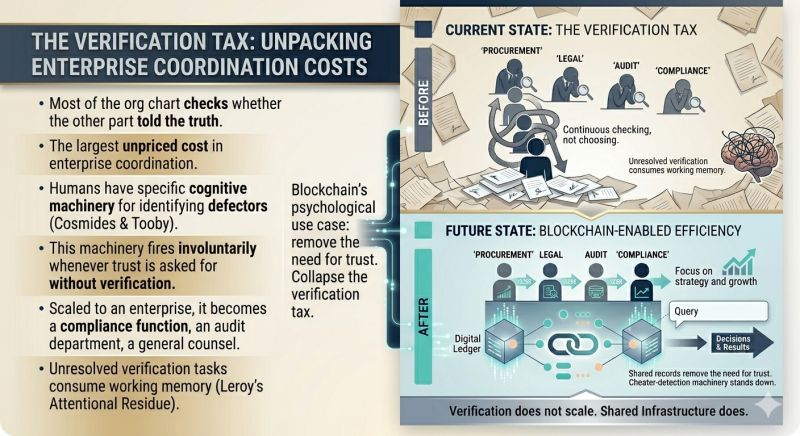
Procurement verifies vendors. Legal verifies procurement. Audit verifies legal. Compliance verifies audit.
Somewhere in the stack, someone is making a decision. Most of the org chart is checking whether the rest of the org chart told the truth.
This is the largest unpriced cost in enterprise coordination.
Why the cost is invisible
Cosmides and Tooby's work on evolved cheater-detection showed humans have domain-specific cognitive machinery for identifying defectors in cooperation — machinery that fires involuntarily whenever trust is asked for without verification. It evolved for small-group cooperation.
Scaled to an enterprise, it becomes a compliance function, an audit department, a general counsel's office.
Leroy's research on attentional residue explains the second-order cost. Unresolved verification tasks consume working memory even when you're not actively working on them. Senior work is mostly checking, not choosing, and the checking outlasts the meeting.
What blockchain actually does
The blockchain conversation is mostly about decentralization ideology. The business case was always psychological.
A tier-3 supplier attestation that takes three weeks, forty pages, and six signatures collapses into a query. The cheater-detection circuitry can stand down — not because the counterparty became trustworthy, but because the question no longer applies.
Blockchain does not verify whether what enters the ledger is true. It does not resolve disputes that are not reducible to records. What it does is collapse the verification tax on the middle layer of enterprise work, where both parties already agree on what should have happened and are only arguing about whether it did.
The pattern is older than the technology
Trust does not scale. Verification infrastructure does.
- Double-entry made fraud arithmetically detectable.
- Chartered accounting made professional liability the enforcement mechanism.
- The SEC made disclosure a precondition for capital access.
Blockchain is the next answer to the same question every durable institution has had to solve: how do two parties agree on what happened, cheaply, at scale?
The ones who understand this will stop paying their best minds to prove last quarter actually happened.
The ones who don't will keep calling it overhead.