On this page
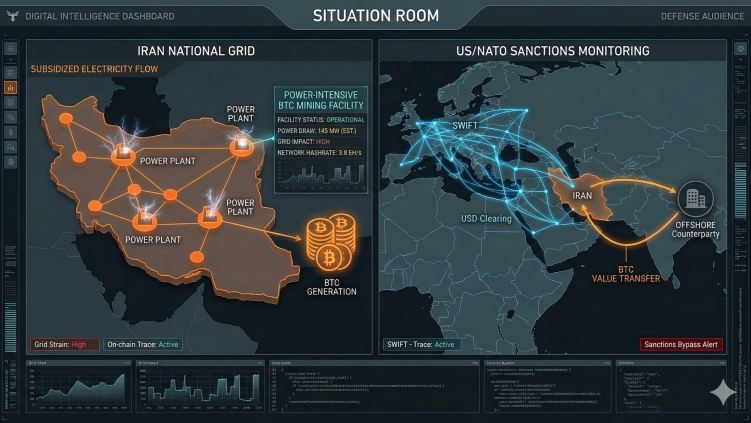
Iran can mine a single Bitcoin for roughly $1,300.
Sold at a $73,000 spot price, that's a 55x return on every dollar spent mining — increasing their ability to pay overseas suppliers for machinery, fuel, and military components without touching a single US-controlled financial system.
The sanctions architecture America spent twenty years building? Routed around with cheap electricity.
Blockchain is also the intelligence layer
But here's what most coverage is missing about the current Iran conflict:
When airstrikes hit Tehran, crypto outflows from Iran's largest exchange spiked 873% above average — visible on-chain before traditional intelligence channels had confirmed the full scale of the strikes.
Real-time financial signal intelligence. Public ledger. No classified infrastructure required.
It's not just Iran
Iran is just the latest case. Russia processed $93B through a sanctioned stablecoin. North Korea stole $1.5B in a single hack and wired it straight into its weapons program.
The doctrine to counter all of this does not exist yet.
What a counter-doctrine would have to do
The old sanctions stack rested on three controls — the SWIFT messaging layer, correspondent-bank dollar access, and OFAC's secondary-sanctions threat against banks that touched designated counterparties. All three were upstream of the actual money movement. They worked because the money had to pass through a regulated bank to settle.
Mined Bitcoin sold for OTC dollars to a willing buyer abroad never touches that stack. Neither does a stablecoin transfer routed through a self-custody wallet in a jurisdiction that does not enforce US designations. The choke points still exist for fiat off-ramps, but the on-chain segment of the trade is invisible to the old toolkit and visible to the new one — public blockchain analytics — that Treasury and DOJ are only now staffing for at the necessary scale.
A real counter-doctrine would have three pieces:
- On-chain SIGINT capacity — staffed at intelligence-agency scale, not contracted to two or three vendors. The 873% Tehran outflow signal was visible to anyone watching; the gap is institutional, not technical.
- Stablecoin issuer leverage — codified rules of engagement for Tether, Circle, and Paxos that look more like correspondent-bank obligations than fintech terms of service. The GENIUS Act is the early frame; the implementation work is unfinished.
- Off-ramp targeting — sanctioning the specific exchanges, OTC desks, and payment processors that convert sanctioned on-chain flows into spendable fiat, rather than the parent protocols that cannot be sanctioned in any meaningful sense.
What this means for an operator
For a US business with international exposure, the practical implication is narrower: compliance frameworks built around the old stack will under-detect risk that has already migrated on-chain. The audit question is whether your sanctions screening covers wallet-level designations and stablecoin issuer freezes, not just SDN lists against named entities. Most don't yet.
The sanctions architecture is not obsolete in the sense that it no longer works. It is obsolete in the sense that it works on a shrinking surface of the actual financial system. The interesting question is who builds the next layer.