On this page
Last week, Iran started demanding Bitcoin from oil tankers passing through the Strait of Hormuz.
Everyone covering this story thinks they're watching American decline. It's the opposite.
The pivot from stablecoins to Bitcoin
For years, the IRGC ran on USDT. Fast. Liquid. Dollar-pegged. They moved roughly $1 billion through stablecoin rails before the toll system even started.
Then Tether started freezing wallets.
Over $3.3 billion frozen to date. $6.7 million tied to IRGC and Houthi networks in March alone.
So Iran pivoted to Bitcoin. Explicitly. On the record. Because no one can freeze it.
That one detail rewrites the story most people think they understand.
The GENIUS Act accelerated it. Tether and Circle now behave like quasi-sovereign actors who can freeze adversary capital in real time.
Bitcoin is what's left when that door closes. Neutral. Censorship-resistant. The pressure release valve for transactions the dollar system genuinely can't serve.
Where it gets interesting
Bitcoin has a hard cap. 21 million.
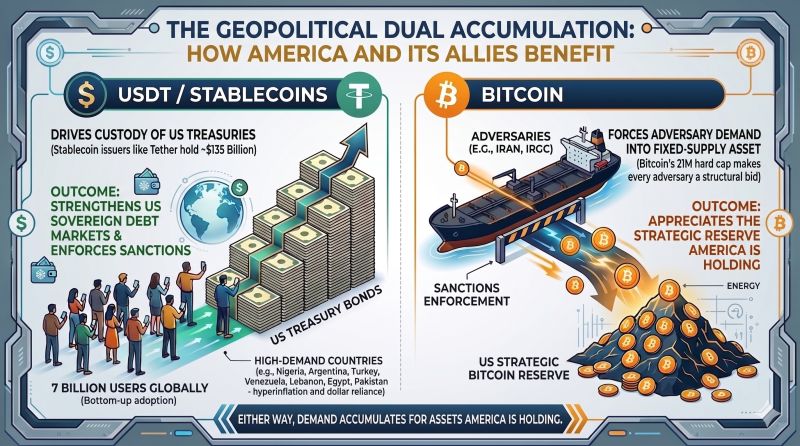
When Iran denominates its sanctions evasion in Bitcoin, they're pushing demand into a fixed-supply asset the US Strategic Bitcoin Reserve is also holding. Every adversary forced onto Bitcoin rails is structural bid on an asset America is accumulating.
Read that again.
We enforce sanctions through stablecoins. Adversaries escape to Bitcoin. Bitcoin appreciates. The US Treasury balance sheet thanks them. Simple supply and demand.
It might be the cleanest trade in geopolitics.
The doom take, with a fresh angle
Now the doom take you've heard a hundred times, with a fresh take.
Iran sells 80% of its oil to China, increasingly in yuan. Russia–China trade is settling in ruble–renminbi. The dollar's share of global reserves dropped to 56.77% in 2025 — the lowest since 1995.
All real. All the wrong altitude.
While Moscow, Beijing, and Tehran cut deals to bypass dollars at the top of the stack, 7 billion people are walking themselves into dollars at the bottom.
530 million USDT users. Growing by 30 million a quarter. Nigerians whose currency lost 90%. Argentines after the peso collapsed. Turks. Lebanese. Venezuelans. Increasingly Egyptians and Pakistanis.
None of them needed our diplomacy. They needed a $40 phone.
The mechanism almost nobody connects
Every new compliant stablecoin dollar forces demand for US Treasuries. Tether alone holds ~$135 billion — the 17th largest holder of US debt globally. Ahead of South Korea. Projected to enter the top 10 this year.
China dropped from $1 trillion+ to $756 billion. Stablecoins are filling the gap.
So here's where we actually are.
Stablecoins strengthen US debt markets. Bitcoin strengthens the strategic reserve America holds.
We're not watching the end of the dollar. We're watching its second act.