On this page
Modern cyber warfare increasingly rewards stealth.
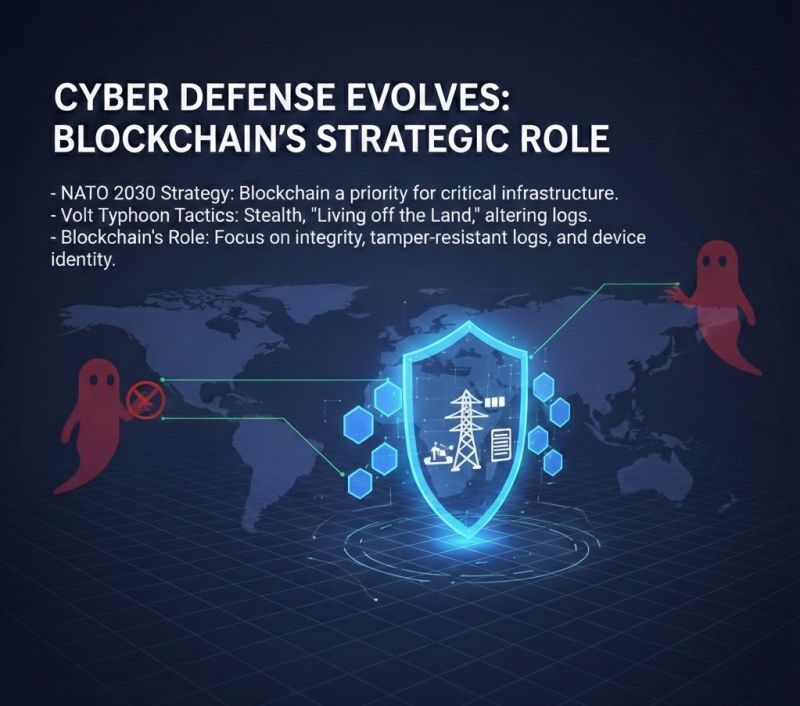
Actors like Volt Typhoon illustrate this shift. Rather than deploying obvious malware, they use legitimate administrative tools already inside a network — a technique known as Living off the Land. They blend in, move laterally, and establish persistence. One of their most effective techniques is altering or deleting logs to obscure their presence.
This is where distributed ledger technology (DLT) enters the strategic discussion.
What's actually being explored
In the U.S., the Department of Energy and national laboratories such as PNNL are exploring blockchain-based systems to strengthen grid resilience.
- Immutable audit trails: Distributed ledgers can anchor cryptographic hashes of critical logs to a tamper-resistant record, making post-compromise alteration provable even if endpoints are breached.
- Cryptographic device identity: Projects like BLOSEM aim to assign verifiable identities to grid-connected devices, reducing spoofing and unauthorized manipulation.
Within NATO, blockchain exploration includes:
- Supply chain integrity: Verifying that firmware and software updates have not been intercepted or modified before reaching routers and critical systems.
- Decentralized resilience: Reducing reliance on centralized architectures that create high-value single points of failure.
In practice, most defense implementations would likely rely on permissioned, Byzantine fault-tolerant consensus models rather than public proof-of-work networks, balancing integrity guarantees with operational latency constraints in critical infrastructure environments.
Honest framing
To be clear, most of these initiatives remain in pilot programs and experimental exercises. The primary defense against actors like Volt Typhoon continues to be cybersecurity fundamentals — phishing-resistant MFA, aggressive patching of edge devices, and network segmentation.
Blockchain is not a silver bullet.
But it reflects a strategic evolution.
In an environment where adversaries aim to blend into normal operations rather than trigger alarms, the ability to make tampering provable may become as important as perimeter defense.
If breach is inevitable, is integrity the new perimeter?