On this page
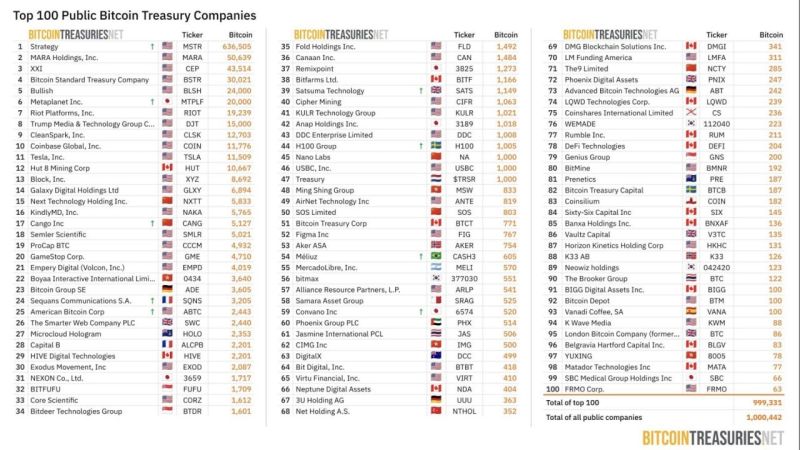
Public companies now hold more than 1,000,000 BTC — close to 5% of the total supply that will ever exist. The composition matters more than the headline.
Strategy (formerly MicroStrategy) sits at the top with more than 580,000 BTC, financed largely through convertible notes and equity issuance. Marathon, Riot, and CleanSpark hold meaningful treasuries from mined production. A second tier — Tesla, Block, Coinbase, Semler Scientific, Metaplanet in Japan — holds Bitcoin as a deliberate treasury policy, not a marketing posture.
What changed to make this possible
FASB's December 2023 update (ASU 2023-08) lets companies carry Bitcoin at fair value with gains and losses flowing through net income, rather than treating any price dip as a permanent impairment. That single accounting change removed the asymmetric reporting penalty that kept CFOs out for a decade.
Spot Bitcoin ETFs cleared a separate barrier on the demand side. They now hold over 1.3 million BTC and create a custody and reporting model that boards can underwrite without becoming crypto operators themselves.
What the concentration actually does
Held coins are not the same as locked coins, but corporate treasuries have a different turnover profile than retail. Strategy's stated policy is permanent hold; ETF supply moves only at the marginal rate of net redemption. That shifts the price-discovery base from a wide pool of fast traders to a thinner pool of long-duration holders.
Where this is fragile
The leveraged accumulators are the load-bearing risk. Strategy funds its purchases with convertible debt; a deep, sustained drawdown that triggers margin or refinancing stress could force selling into the same liquidity gap that made the position profitable on the way up. The thesis works when the marginal corporate buyer is well-capitalized and unforced. It breaks when the marginal seller is leveraged and forced.
The mature version of this story is not "every company will own Bitcoin." It is "treasury policy now has a fourth allocation question alongside cash, T-bills, and FX." For most boards, the work is no longer whether to consider it. It is who in the org is qualified to answer when the audit committee asks.